Sunday, 16 July 2017

Usha Ispat is LIC's largest defaulter


RBI Defaulters List: Meet the Top 10
You thought Vijay Mallya owes banks money? Kingfisher is actually small fry compared to Usha Ispat, Lloyds Steel and others

When we started investigating this story two months ago, one thing we didn’t anticipate was a situation in which we’d find ourselves using ¯\_()_/¯ while writing about the top 10 defaulters in India, as of December 25, 2015. (That’s a shruggy in case you didn’t know.)
Check out their names below.
Top 10 Companies/Rs Crore
In the first part of this series, Newslaundry introduced key elements of RBI’s Wilful Defaulters and Defaulting Borrowers List, which places corporate bad debts in the banking system at Rs 5 lakh crore as of December 24, 2015.
These are accounts against which banks have not taken any legal action. In banker-speak, they are non-suit filed accounts. Of these accounts, only Rs 1.08 lakh crore are labelled as wilful defaults.
It is not normal practice the world over to put out bank defaulter names. Our case is different since in India, the banks involved are state-owned and many of the companies are public sector undertakings. Add to that the size and seriousness of the NPAs in the banking system, and public disclosure is a crucial way to put pressure on the powers that be to expedite important reforms in the way banks classify and treat defaults  as well as in the way the legal system is geared to handle bankruptcies.
Newslaundry sent a detailed questionnaire to all the above companies to get their side of the story. None of them have responded yet. The story will be updated if and when they do. We also reached out to Reserve Bank of India spokesperson Alpana Killawala by email, text and phone calls. We are yet to receive a response from her too.
Steel and the metals and mining sector feature prominently on the list of top 10 defaulters. Heavy industries and mining have generally been at the centre of scandals involving political corruption, due to the number of licenses and government approvals required. The owners of these companies —  like Usha Ispat, Malvika Steels, Lloyds Steel and Prakash Industries — have seemingly benefited from political and regulatory forbearance when it comes to their debts.
Of the 10 companies, four are public sector undertakings: Hindustan Cables, Hindustan Photo Films, Prag Bosimi and Malvika Steel (which was bought over by SAIL from Usha Group in 2009). Both Hindustan Cables and Hindustan Photo Films are declared terminally sick, and the former may shut down soon. Prag Bosimi Synthetics is the only industrial venture of public-private partnership in the Northeast. It started operations in 2012 after remaining shut for a decade. PSU companies have defaulted the most to public sector banks and financial institutions, which means the taxpayer loses money twice over in case the PSU shuts down.
Mismanagement, therefore, is evident when it comes to both the lenders and the borrowers. It is not hard to imagine the lax standards followed when public sector banks lend to public sector companies, as well as the tolerance shown for their defaults. It also points to the subjectivity of the wilful default classification as none of these companies are labelled wilful.
Zoom Developers defaulted on Rs 3,843 crore, out of which Rs 137 crore are labelled as wilful default even though Zoom Developers owner Vijay Chaudhary was charged by the Enforcement Directorate for diverting bank loans for realty projects in Europe and according to some accounts, he has been absconding since 2014. Zoom features on CIBIL’s list as the top-most wilful defaulter (suit-filed accounts). Why, then, are some of Zoom’s accounts non-wilful defaults?
Another anomaly is Kingfisher India, which has been dubbed a wilful defaulter by various banks but features on the RBI list as just a defaulter. Kingfisher’s bad debts amount to Rs 3,259 crore. Again, these are non-suit filed accounts. As newspaper reports cite, Kingfisher owes in excess of Rs 9,000 crores to a consortium of lenders led by State Bank of India (SBI). Which means Kingfisher owes about Rs 12,000 crore to banks.
Lloyds Steel and Cranes Software don’t have any criminal cases against them. However, reports suggest that Lloyds was listed as one of the top wilful defaulters in Maharastra in 2002. Uttam Galva took over the loss-making company in 2012 for a stake of 58.3 per cent and it was renamed Uttam Value Steels in 2013.
Cranes Software International, in 2010, was going to be delisted from the National Stock Exchange due to continuous late filing of their financial statements. It is still traded on the Bombay Stock Exchange. Cranes Software Co-Founder Asif Khadar has stated that most of its business comes from exports and has suffered due to the global recession following the 2008 financial crisis. Seventy per cent of Cranes Software’s debt is labelled wilful in the RBI list.
Then there is the case of Prakash Industries whose promoter Ved Prakash Aggarwal and Director Vipul Aggarwal were arrested in August 2014 for offering bribes to get credit from Syndicate Bank. According to a 2012 story by Tehelka, Ved Prakash Aggarwal’s brother JP Aggarwal ran Surya Foundation, which is an NGO that conducts poll surveys for the Bharatiya Janata Party. Prakash Industries was raided by the CBI for selling coal in the black market.
However, the name on the list that is the cherry on the default cake, in every possible way, is Usha Ispat. Usha Ispat owes banks and lending institutions almost Rs 17,000 crore and has been defaulting at least since 2005.
The company is owned by Usha India Limited, which also features on RBI’s list and has defaults worth Rs 2,828 crores. The group is family-run and owned by brothers Vinay Rai and Anil Rai. In 2002, the Central Bureau of Investigation raided the premises of both the brothers for allegedly duping financial institutions of over Rs 100 crore. Newspaper articles from the time painted Vinay Rai as a Mallya-esuqe figure, with a personal net worth of Rs 5,338 crore.
Usha Ispat’s defaults as noted on the RBI list are as recent as March 31, 2013. Effectively, the company has been getting loans and defaulting on them for more than a decade despite CBI raids, FIRs and The Serious Fraud Investigation Office initiating proceedings against its promoters. Only Rs 5,093 crore of Usha Ispat’s total defaults are labelled as wilful according to the RBI’s list. Usha Ispat owes more than half of the total default sum to LIC at Rs 8,619 crore.
A Financial Express report, headlined “How the Rais roll in money but won’t pay back”, states that the CBI suspected the Usha Group of taking “money from banks and financial institutions by showing fake bills for purchase of machinery from its own front companies”. The article also mentions Rai’s political clout.
Interestingly, Usha Group also owned Malivika Steel, which defaulted on Rs 3,057 crore. Malvika Steel was acquired by SAIL in 2009 during the UPA-II regime. The steel plant is located in Jagdishpur, in Amethi district, and has defaulted on loans since 2007. All of its loans are owed to either General Insurance Corporation, Mumbai, or Life Insurance Corporation. According to a Hindu Business Line report, the Modi government pulled the plug on the plant’s revival in 2014 and it may be up for sale now -- Rs 300 crore had been sunk into the project in the United Progressive Alliance (UPA) regime. We have to wonder how much of a part Rai’s political connections played in Usha Ispat staying under the radar for as long as it has, especially since the company seems to be about as substantial as Casper the Friendly Ghost.
Our emails to Usha Ispat’s director Amit Kumar bounced back. According to the RBI’s list, Usha Group’s office is in New Delhi’s Mohan Industrial Area. Our calls to the office yielded no result since these numbers are no longer in use. When we visited the office, we were told that the Usha Group no longer operated there. As of its most recent filing, in 2014-15, Usha Ispat has had zero revenues over the past two years. The company has no web presence. Its office is registered in what appears to be residential complex in Pune. Newslaundry has also posted a letter with questions pertaining to its huge default and is waiting for a response.
Update: Cranes Software has responded to Newslaundry stating that the total amount due to Indian banks, as provided in the company’s audited published balance sheet, is Rs 649.24 crore. For more details read here.
The authors can be contacted on Twitter @MnshaP and @garimachitkara

Friday, 16 June 2017

The Government banks on LIC to bail it out!

Source:
https://www.newslaundry.com/2016/04/27/rbi-defaulters-list-curious-case-lic
RBI Defaulters List: The curious case of LIC
The insurer has become the lender of the last resort
Posted By Aman Malik | Apr 27, 2016 0 Comments Exclusive
A curious feature of the Reserve Bank of India’s Willful Defaulters and Defaulting Borrowers List is that it features Life Insurance Corporation of India (LIC) as the largest lender. According to RBI’s list, till the end of the September-December quarter last year, borrowers defaulted on as much as Rs 65,700 crore that LIC had lent them. In effect, a substantial amount of the Rs 5 lakh crore that is under default as of December 25, 2015, was actually lent not by public or private sector banks, but by this government-owned insurer.
The list shows that Usha Ispat, the top corporate defaulter, owed Rs 8,619 crore to LIC as of the end of December last year. Another major defaulter Prakash Industries owed the public sector insurer more than Rs 2,171 crore.
To be sure, unlike banks and other lending institutions, LIC does not typically give loans. The government-owned insurer normally buys debt instruments -- bonds or debentures -- from companies that typically want to raise money for long-term needs.
When a corporation or the government wants to raise money for the long term, they typically issue debt instruments called ‘bonds,’ which are then bought either by institutions or by individual investors, as the case may be. Bonds are backed by physical assets, which can be liquidated by the buyers, if the seller fails to return the principal amount at the end of the tenure of the bond. A debenture is also a debt instrument, but slightly different and riskier than a bond. Unlike bonds, debentures are not backed by physical securities and are therefore riskier assets to buy.
Interestingly, though, LIC, like all other insurers, is governed by the Hyderabad-based Insurance Regulatory and Development Authority (IRDA). It is therefore unclear why the RBI would monitor LIC’s lending activity. One plausible reason could be the fact that LIC has significant stakes in public sector banks, which have all been terribly hit by the bad loan crisis.
J Hari Narayan, a former IRDA chief told Newslaundry over the phone that while he was unaware of the RBI tracking LIC’s lending activity in the past, his presumption was that “since the RBI is looking at the health of financial institutions, and how loan portfolios are behaving generally, [the RBI] probably would have got information from the LIC.”
Narayan said that the LIC works “under very tightly guarded investment rules” and that he therefore suspected that “these were investments made prior to IRDA.” The IRDA was set up in April 2000. The RBI list notes defaults triggered from 2005 to 2013.
Narayan said the investment regulations for insurers came into being from 2001, and “since then they have been more and more vigorously enforced.” He added that apart from tough investment rules, the LIC also had very stringent audit regulations.
Not only is the LIC the second-largest shareholder in government banks, after the government itself, it has, of late, been on a share buying spree. Just last month, it was reported that the insurer had been mopping up shares in several banks, including IDBI Bank and Dena Bank.
In fact, since the beginning of 2016, LIC has upped its stakes in several other public sector banks via what is called ‘preferential allotment’ of shares. Apart from IDBI Bank and Dena Bank, it has bought shares in Allahabad Bank, Indian Overseas Bank, Corporation Bank, Bank of India and Oriental Bank of Commerce.
This way, it has also helped these banks raise much-needed funds. This even as share prices of government banks declined by more than 11% between January and March this year.
To be sure, although insurance companies are not allowed to invest in unlisted entities, there is a small window that allows them to invest in what are typically called ‘junk shares.’ Also called ‘penny stocks’, these are shares of small companies that trade at low prices and are therefore considered extremely risky. Up to three per cent of their investment portfolio may be invested in such shares.
By a conservative estimate, LIC has a total investment portfolio of the order of Rs 25 trillion, which would mean that it might have invested up to Rs 75,000 crore into such penny stocks.
Since LIC is not listed, it is extremely tough to arrive at its valuation. A report in 2014 had said if it were to list, LIC would be the largest Indian company with a market capitalisation of Rs 5 trillion. At current prices, this would compare with Tata Consultancy Services, which at Rs 4.97 trillion is India’s most valuable company by market capitalisation.
Two financial sector analysts who spoke to Newslaundry said the government has, on many occasions, informally asked LIC to take such contrarian calls, to bail itself or institutions owned by it, out. “LIC has virtually become a sort of lender of last resort to the government. It can afford to do it since it has deep pockets,” one of the two analysts said.
In the last few years, the government has struggled to meet its disinvestment targets, mainly because adverse market conditions have ensured that there have been few takers for shares of government companies.
In almost all such cases, the LIC has been pushed forth to buy up shares on the day of the stake sale. A classic case was the share sale of Indian Oil Corp. Ltd in August last year, when LIC was indirectly forced to buy up almost nine-tenths of the refiners shares on offer just to salvage its Rs. 9,000 crore share sale. Earlier in January 2015, LIC had mopped up nearly half the Rs. 22,500 crore worth of shares put on the block by Coal India Ltd.
In fact, as this report points out, a third of the government's disinvestment receipts since 2012-13 have come from LIC.
Newslaundry reached out LIC with a detailed questionnaire on its presence on an RBI list and the nature of these loan defaults to corporations. We have not received a response yet. The story will be update if and when we receive a response.
The author can be reached on Twitter @PatrakaarPopat
Disclaimer : The information, ideas or opinions appearing in this article are those of the author and do not reflect the views of Newslaundry.com. Newslaundry.com does not assume any responsibility or liability for the same. If the article carries photographs or images, we do not vouch for their authenticity.

Monday, 1 May 2017

This International Labor Day, LIC must be brought to book!


Dear friends,
                    Today must be the day of reckoning for L.I.C of India, our ex-employer, which has unjustly deprived us of our rightful dues, since two decades. It must come to its senses today, wake up and undo its wrong-doing towards us. Will this International Labor Day prove to be lucky for us, or just fade away into History like the past ones? 
                    All of us must unite and collectively fight for our legal dues, with all our might. Let's wake up the sleeping giant!
                                                                                                                                 Priya
P.S. This post was carried verbatim, last year too, on this day! How many more of such International Labor Days must pass by, for LIC to come to its senses, undo its wrongdoings and bestow justice; regard the Supreme Court's judgments for a change?
        It's high time that the Prime Minister and the Finance Minister stepped in, to put in a strong word for the long-suffering, resigning ex-employees.
        When defaulters like some of the Sahara Group of Companies and Kingfisher Airlines have been brought to book, why not LIC?

Wednesday, 19 April 2017

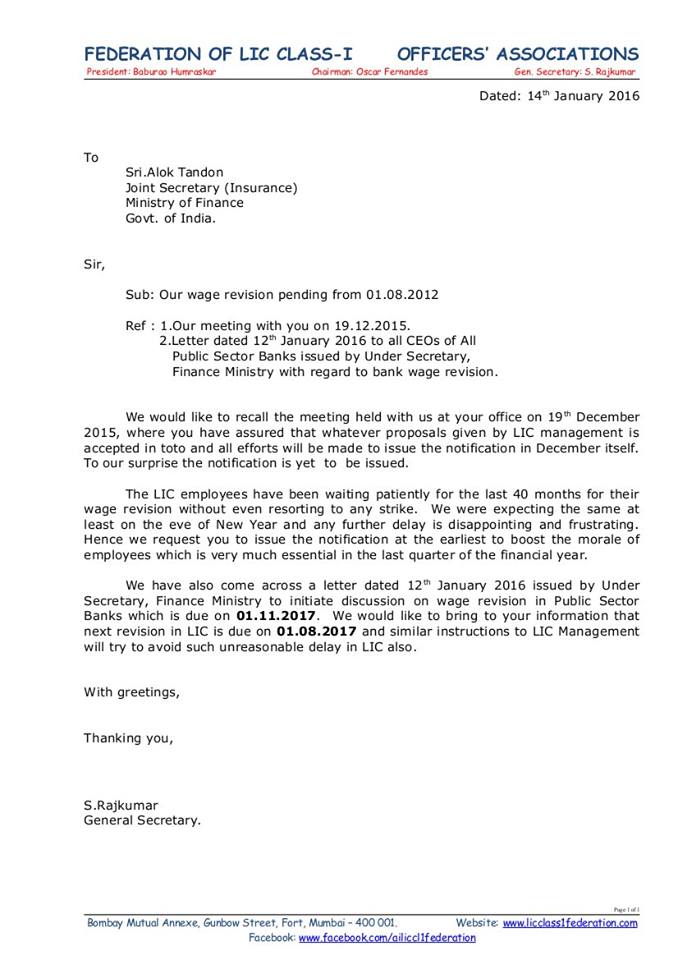
Next Wage Revision due in LIC and GIC - 01.08.2017

Source: http://examsbuzz.in/wage-revision-2017-lic-gic-gipsa-updates

January 14, 2016 (Letter of Unions to Finance Ministry)
wage revision 2017 lic gic

Thursday, 30 March 2017

Wage Revision Notification signed by Jt.Secy (I&P), MOF, Govt. Of India


LIC wage revision agreement signed. Gazettee notification soon.


LIC              October, 9,2010

    It is learnt from reliable source that the notification for LIC wage revision has been signed by Jt. Secy (I & P), MoF, Govt of India on 8th October 2010 and sent to press for printing. More details are awaited and will be uploaded as soon as available

Source - Paycommissionupdate
My question to the honorable Jt. Secy (I &P), MOF, Govt. of India
Had you considered the Supreme Courts judgment dated 3rd December, 2007; before signing the aforesaid notification?
An excerpt from this judgement :
SC - "Proviso of Para 3 is struck sown ultra vires"

Supreme Court Decision - GIC

 K. S. Raina.                                                                                       -      ------------Petitioner.
                        Versus
Union of India and others.                                                                         --------Respondents.
Coram:
The Hon’ble Mr. Justice Rajiv Sharma, Judge.
Whether approved for reporting?*                                    Yes.
For the Petitioner:                                                  Ms. Ranjana Parmar, Advocate.
For Respondent No. 1:                                         Ms. Shilpa Sood,
Central Government Counsel.
For Respondents No. 2 & 3:                                Mr. Ashwani Sharma, Advocate.
Rajiv Sharma, J.
(Excerpt)
In the present case the petitioner was in fact in employment as on 1st August 2002, the date from which the Notification (Annexure P-4) dated 21st December 2005 has been made applicable.
Consequently, in view of the observations made above, send proviso of Para 3 of the Notification dated 21st December 2005 is struck sown being ultra vires to the extent it deprives the petitioner and other similarly situated persons to get the benefit of revised pay scale with effect from 1st August 2002 after applying the principle of severability.
According, the petition is allowed. The petitioner is held entitled to get the revised pay scale corresponding to his post he was occupying as on 1st August 2002 till 15th March 2004. The respondents are directed to work out the arrears etc. within six weeks from today.
December 3, 2007                                                                                      (Rajiv Sharma), J.
Isn’t the concerned official who signed the notification, liable for Contempt of Court proceedings against him?
Aren’t the members of the Managing Board of Directors, including the Chairman of LIC of India; too, liable for Contempt of Court proceedings against them?
                                                                                                                            Priya

Saturday, 11 February 2017

Completing 5 years of my crusade against LIC's injustice, today!

Dear friends,
                     I filed an RTI application on the 11th of February, 2012 for getting information about the  unjust and illegal repudiation of arrears to the resigning employees during implementation of the Wage Revision Charters of LIC of India. Needless to say, this was done as I didn't get any reply from LIC, to my representations for payment of arrears and difference in retirement benefits due to me, for 8 long months! Thus I started a crusade for getting replies to all questions plaguing my mind and indeed every other resigning employee's mind; as to the reasons for repudiation.
                     After first and second appeals and endless correspondence, all that I could manage to get from LIC was that: This injustice was going on since 1st August, 1997, (exactly 2 decades ago), names of a handful of employees (not the entire list as asked for), it didn't have the Minutes of meetings for the same (rather didn't want to give them to me, for obvious reasons), didn't have reason for the repudiation, on its records (thus admitting that its decision was arbitrary) and that it didn't have all the information asked for by me (speaking volumes about the ethics, accounting and record-keeping practices of LIC)! So much for transparency and honesty, by a distinguished Public Authority!
                     Till date, the details of my RTI application and the subsequent 1st and 2nd Appeals have not been uploaded by LIC on its website, as is mandated for Public Authorities.
                      I have compiled a list of ex-employees affected by repudiation, but there are many more names that still remain missing from my list and I hope that the concerned ex-employees will inform me at the earliest so that I can take my crusade to the next level.
                      In spite of contacting all the major dailies and several publications, I haven't received any support from them, which makes me wonder about their unusual reticence in highlighting this important issue.
                      If a reputed Public Authority like LIC of India can heap such injustice on its employees who have sincerely worked for its progress, is there any guarantee that it wouldn't do the same to its esteemed and invaluable policy-holders, in the long run? It has also deprived the Central Exchequer of the income-tax payments which would've been deducted from these arrears' payments, had they been made to the resigning employees!
                      In spite of the Supreme Court's judgments favoring the employees, LIC continues incorporation of the Clause 3 1 B which has been declared ultra-vires by the Supreme Court; in each Charter of wage revision; and repudiates arrears' payments with impunity. Thus it defies the laws of the land with utter contempt. Should we allow LIC to get away with it or bring it to book at the earliest?
                      Think about it!
                      Nevertheless, I pledge to keep the mast flying high till the end result is achieved, in the form of payment of dues to all the aggrieved ex-employees. Come, join me in my crusade against injustice.
                       SATYAMEVA JAYATE! THE TRUTH ALWAYS PREVAILS!
                                                                                                                                   Priya

Wednesday, 4 January 2017

Negotiations by Class I Officers' Associations - 1997


Source: http://www.business-standard.com/article/specials/lic-officers-demand-bank-grade-pay-packet-197100401007_1.html

Business Standard

Lic Officers Demand Bank-Grade Pay Packet
BSCAL 
The Life Insurance Corporation Class I Officers Association is firming up its demands to be presented before the management for the forthcoming round of wage negotiations. A few days ago, office bearers of the association from all over the country met in Mumbai to finalise their agenda. Speaking to Business Standard, O P Vashisth, general secretary, Federation of LIC Class I Officers Association, said the final charter will be finalised shortly and presented to the management by the end of this month.
The LIC Officers Associations have decided to oppose the central governments attempts to privatise the insurance industry. They are also unhappy that the management of the corporation has not brought the salaries of the insurance officials at par with that of bank officers. They are also demanding rationalisation of the pay structure within the organisation. Vashisth said the association is likely to adopt a tough stance, especially on the issue of parity with bank officers.
He said that on August 17 last, the National Confederation of General Insurance Officers Associations (NCGIOA) and the Federation of L I C Class I Officers Association had decided to form a common front for negotiating on issues pertaining to privatisation and pay revision. This decision has been taken keeping in view the pay revision which fell due on August 1 this year. It was then decided that the two associations would submit a similar if not a common charter of demands to the management of LIC and General Insurance Corporation.
According to an official with the association, efforts are on to evolve a common charter of demands. The pact had been signed following a meeting between the associations. The officers expressed concern for protecting the policy holders interest and the flow of funds to the infrastructure sector.
He said it was unfortunate that the government has not yet implemented the proposal that gave the management of LIC the right to negotiate with the officers and unions directly.
It might be recalled that the finance minister while presenting the budget for 1997-98 had come up with this proposal.
**********************************************************************************

Kindly refer to my blog dated 09.04.2016 titled